
By Alison Rosen | Last Updated: January 26, 2026 | 6 min read
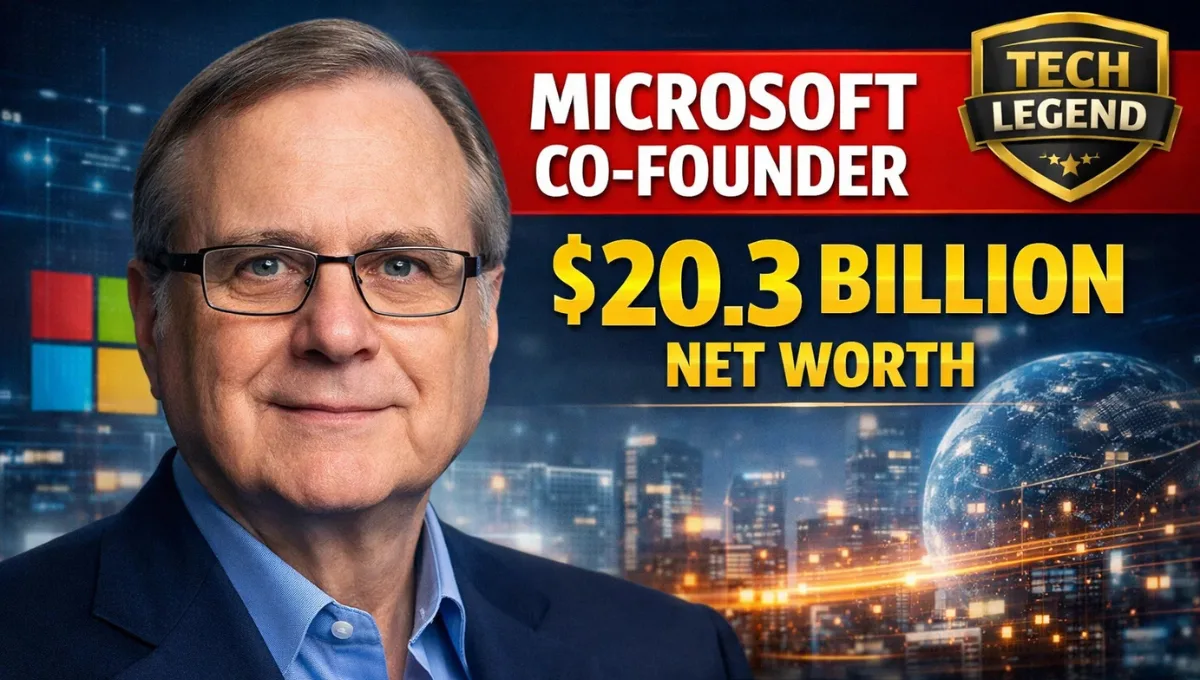
Paul Allen Net Worth: Paul Allen, the legendary co-founder of Microsoft, passed away on October 15, 2018, leaving behind an estimated net worth of $20.3 billion. His estate remains one of the largest tech fortunes in history, managed by his sister Jody Allen through trusts and the Paul G. Allen Family Foundation.
While Paul Allen is no longer living, his financial legacy continues to impact technology, sports, philanthropy, and scientific research worldwide. His estate holdings include the Seattle Seahawks, Portland Trail Blazers, vast real estate portfolios, art collections, and ongoing investment ventures.
Net Worth at Death
At the time of his passing in October 2018, Forbes ranked Paul Allen as the 44th wealthiest person globally with an estimated net worth of $20.3 billion. Some sources cited his wealth at $20 billion, while others estimated it between $20 and $21.7 billion depending on market valuations.
The variance in estimates reflected the difficulty in valuing his private holdings, sports team ownership, art collections, and real estate portfolio, which aren’t traded on public markets.
Estate Value in 2025-2026
As of October 2025, the estate still anchors in the tens of billions, but the precise figure is private and moves with markets, team valuations, asset sales, taxes, and ongoing giving. Since his death in 2018, Microsoft’s value rose during the AI wave, sports franchise valuations increased, and Christie’s sold part of his art collection in 2022 for more than $1.6 billion.
The estate’s current value is difficult to pin down precisely because assets are continuously managed, sold, donated, and reinvested. His sister Jody Allen serves as chairman of the Paul G. Allen Trust and makes decisions about asset management and philanthropy.
Sam Darnold Net Worth 2026: Seahawks QB Worth $45 Million After Career Resurgence
How He Built His Fortune
Allen earned his initial wealth as the co-founder of Microsoft alongside Bill Gates in 1975. On the day Microsoft went public in 1986, Paul Allen owned 25% of the company’s equity. After the first day of trading, his 25% stake was worth $195 million when he was just 33 years old.
Allen left Microsoft in the mid-1980s after a management dispute with Bill Gates but stayed on the company’s board of directors until 2000. At one point, Allen owned roughly 8% of Microsoft’s shares, making him one of the largest individual shareholders.
After leaving Microsoft, Allen invested his wealth into a diversified portfolio managed through Vulcan Inc., his private investment company founded in 1986 with his sister Jody Allen.
Major Holdings and Investments
Allen’s wealth came from multiple sources beyond Microsoft stock.
Sports Teams: Allen owned the Portland Trail Blazers (NBA) and the Seattle Seahawks (NFL), with the Seahawks winning Super Bowl XLVIII under his ownership. He was also part-owner of the Seattle Sounders FC in Major League Soccer.
Real Estate: Vulcan Real Estate developed and managed $4.3 billion worth of real estate in downtown Seattle. One of the company’s biggest wins was selling a 1.8-million-square-foot office complex to Amazon for $1.16 billion in 2015. Allen’s personal real estate holdings spanned across the US, including a Beverly Hills condo, 11 mansions on Mercer Island and multiple apartments in New York City.
Art Collection: Allen was an avid art collector building one of the world’s most expensive collections. In 2022, Christie’s sold part of his collection for more than $1.6 billion, indicating the extraordinary value of his artistic holdings.
Technology Investments: Through Vulcan Capital, Allen invested in technology and media companies including stakes in tech startups, real estate companies, and scientific research ventures.
Philanthropic Contributions
Allen was deeply committed to giving back. Allen made more than $2 billion worth of contributions toward the advancement of science and technology and to organizations related to health and human services.
The Paul G. Allen Family Foundation has donated more than $500 million to more than 1,500 nonprofit organizations since its establishment in 1988. In 2010, Allen signed The Giving Pledge, an initiative whose signatories pledge to give away at least half of their wealth to philanthropic causes.
Allen funded microgrids in Kenya to promote renewable energy and support local businesses and residents. He invested in Mawingu Networks and Off Grid Electric to provide solar energy to people in emerging nations. In 2014, Allen pledged at least $100 million toward fighting the Ebola virus epidemic in West Africa, making him the largest private donor in that crisis.
Institutes and Cultural Institutions
Allen established several non-profit institutions during his lifetime:
Museums and Collections: The Museum of Pop Culture (MoPOP) is a nonprofit museum dedicated to contemporary popular culture in a Frank Gehry-designed building at Seattle Center, established in 2000. The Flying Heritage Collection showcases restored vintage military aircraft and armaments from World War II, established in 2004. The Living Computer Museum opened in 2012 featuring vintage computers in working order. The STARTUP Gallery at the New Mexico Museum of Natural History displays the history of the microcomputer.
Scientific Research: Allen founded the Allen Institute for Brain Science, Institute for Artificial Intelligence, and Institute of Cell Science, dedicated to advancing neuroscience and artificial intelligence research.
Space and Innovation
Allen was the sole investor behind SpaceShipOne, the first privately funded suborbital commercial spacecraft. SpaceShipOne won the $10 million Ansari X Prize in 2004. Allen also founded Vulcan Aerospace and Stratolaunch Systems. On April 13, 2019, the Stratolaunch aircraft made its maiden flight.
Other Notable Ventures
Charter Communications: In 1998, Allen bought a controlling interest in Charter Communications. Charter filed for bankruptcy reorganization in 2009, with Allen’s loss estimated at $7 billion. After emerging from reorganization, Allen kept a small stake worth $535 million in 2012.
Ticketmaster: In November 1993, Allen invested more than $325 million to acquire 80% of Ticketmaster. In 1997, Home Shopping Network acquired 47.5% of Allen’s stock in exchange for $209 million worth of their own stock.
Personal Life and Values
Allen was born on January 21, 1953, in Seattle, Washington. His father Kenneth Sam Allen was a librarian and his mother Edna Faye was a teacher. He attended Lakeside School from 1965 to 1971, where he befriended Bill Gates.
Allen never married and had no children. His sister Jody Allen and her children are his beneficiaries. Allen’s real estate holdings are in a living trust, and there are no plans to sell franchises like the Seattle Seahawks, suggesting his sister and her children will maintain these assets long-term.
Allen was known for his interests beyond business, including music production. In 2013, Allen and his band, The Underthinkers, released their debut blues-rock album, Everywhere At Once, with Allen playing electric guitar alongside friends like Joe Walsh of the Eagles and Chrissie Hynde of the Pretenders.
Legacy Today
Paul Allen’s legacy extends far beyond his $20 billion net worth. His investments in technology, space exploration, scientific research, and cultural institutions continue to shape innovation and discovery globally. The Seattle Seahawks, Portland Trail Blazers, and his various institutes remain active under his estate’s management.
His sister Jody Allen continues managing Vulcan Inc. and implementing his philanthropic vision. The estate’s careful stewardship suggests Allen’s influence will continue for generations through his trusts, foundations, and institutions dedicated to advancing human knowledge and culture.

He is a celebrity finance researcher and content creator specializing in net worth analysis, income breakdowns, and detailed biographies of global public figures. He focuses on delivering accurate wealth insights and success stories on EdenIsle.
1 thought on “Paul Allen Net Worth: Microsoft Co-Founder’s $20 Billion Estate and Legacy”